

Skip to content

ISO 26262 Functional Safety

What It Means for Throttle Pedals and Modern Vehicle Electronics

ISO 26262 has become the global reference point for ensuring the safety of electrical and electronic (E/E) systems in road vehicles. As modern cars rely increasingly on sensors, microcontrollers, and software (from throttle pedals to advanced driver‑assistance systems), the standard provides a structured way to prevent, detect, and mitigate failures that could lead to hazardous events.

What Is ISO 26262 ?

ISO 26262, formally titled “Road vehicles – Functional safety,” is derived from the broader IEC 61508 standard for functional safety of electrical and electronic systems. The automotive‑specific version was first published in 2011 and updated in 2018 to cover all road vehicles except mopeds. 

Its purpose is to ensure that E/E systems behave safely even when faults occur, whether those faults originate from hardware degradation, software defects, electromagnetic interference, or unexpected environmental conditions. This includes safety‑critical driver‑input components such as the throttle pedal, whose malfunction could directly affect vehicle acceleration. 

Although ISO 26262 is not legally binding, it represents the state of the art in automotive safety engineering. Manufacturers and suppliers rely on it to demonstrate due diligence, reduce liability, and ensure that their products meet the expectations of regulators and consumers. In practice, compliance with ISO 26262 has become a prerequisite for participating in the global automotive supply chain, especially when developing systems that interpret driver commands from devices like the throttle pedal.
The Core Purpose of ISO 26262 for safety critical components

At its heart, ISO 26262 aims to prevent unreasonable risk caused by malfunctioning E/E systems. It does so by defining a complete safety lifecycle that spans concept, development, production, operation, and decommissioning. The standard requires manufacturers to identify potential hazards early, assess their severity, and implement safety mechanisms that either prevent faults or ensure the system enters a safe state when faults occur.

A key element of this process is the Automotive Safety Integrity Level (ASIL) classification. Each potential hazard is evaluated based on severity, exposure, and controllability. The resulting ASIL rating, which goes from A (lowest) to D (highest), determines how rigorous the safety requirements must be. Components such as throttle pedals, which directly influence vehicle acceleration, often fall into ASIL B or ASIL C depending on the architecture of the vehicle. 

How does ISO 26262 Apply to Throttle Pedals ?

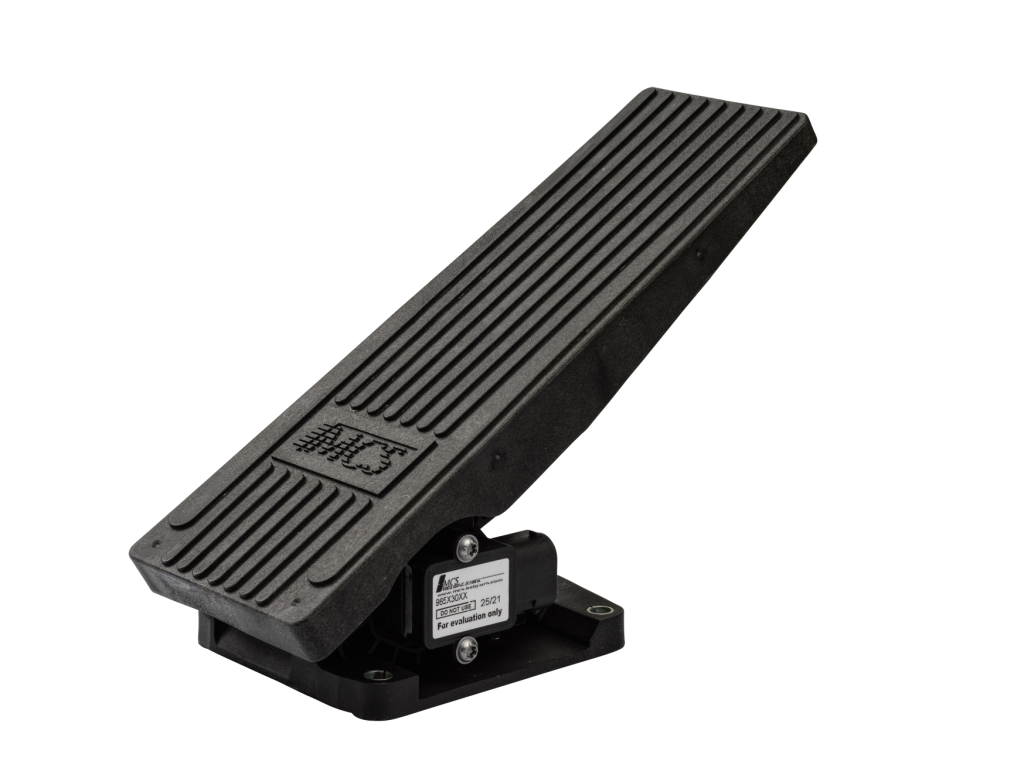
Throttle pedals provide a clear example of why ISO 26262 is essential. Modern vehicles use “drive‑by‑wire” systems, where the pedal’s position is measured electronically and transmitted to the engine control unit. There is no mechanical linkage between the pedal and the throttle body. This design improves responsiveness and efficiency, but it also introduces new safety challenges.

A malfunctioning pedal sensor could cause unintended acceleration, loss of propulsion, or erratic engine behavior. To prevent such scenarios, ISO 26262 requires a structured approach to design and validation. Throttle pedal modules typically incorporate redundant position sensors so that the system can detect discrepancies between signals. The ECU performs continuous plausibility checks, comparing sensor outputs and monitoring for electrical faults. If a problem is detected, the system must transition to a safe state, often by limiting engine torque or entering a limp‑home mode that allows the driver to maintain control while preventing dangerous acceleration.

These safety mechanisms are not optional add‑ons; they are integral to the system’s architecture. ISO 26262 ensures that every step supports the goal of preventing hazardous behavior, from initial hazard analysis to final validation.

electronic throttle pedal 965 000 series

Why ISO 26262 Matters in Today’s Automotive Landscape

The Rise of Automotive Electronics and the Need for Functional Safety

The automotive industry has undergone a dramatic shift from mechanical engineering to mechatronics. In the 1970s, electronics represented only a small fraction of a vehicle’s cost. Today, they account for more than a third, and projections suggest they will reach half of the total cost by 2030. Modern vehicles may contain thousands of semiconductor devices, powering everything from engine control to infotainment and automated driving features.

This migration toward digital control has unlocked enormous performance benefits. Electronic engine management systems can optimize combustion in real time. Digital sensors continuously monitor throttle position, crankshaft rotation, air mass flow, temperature, and exhaust oxygen levels to improve fuel efficiency and reduce emissions. Systems such as electronic power steering, anti‑lock braking, and ADAS rely on precise, fast, and reliable electronic signals to function correctly.

Yet as the number of electronic components grows, so does the potential for failures. A single faulty sensor, corrupted software routine, or electrical disturbance can trigger hazardous behavior. The industry needed a structured way to identify, evaluate, and mitigate these risks. ISO 26262 emerged as the answer.

What are the benefits of ISO 26262 for Manufacturers, Suppliers, and Consumers ?

For Original Equipment Manufacturers (OEMs)

For Suppliers

For Consumers

ISO 26262 Is Essential for Safe Vehicle Electronics

As vehicles become more software‑defined and sensor‑driven, functional safety is no longer optional. ISO 26262 provides the framework needed to ensure that components like throttle pedals, braking systems, steering modules, and ADAS sensors operate safely under all conditions.

By applying rigorous safety processes, redundancy, diagnostics, and lifecycle management, the standard helps the automotive industry deliver safer, more reliable vehicles for everyone on the road.